NESO forecasts adequate but lower supply margins this winter

The National Energy System Operator (NESO) released its Early View of Winter Outlook 2026/27 report on 23 June. This annual report assesses the security of electricity supply from November ‘26 to March ‘27, helping industry to prepare for the winter period.

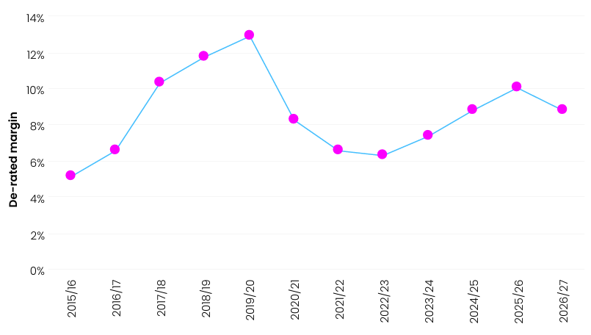
NESO currently forecasts that the de-rated margin will be 5.5 GW. The de-rated margin is the expected spare electricity capacity during Average Cold Spell (ACS) peak demand after NESO has met its reserve requirements, adjusted for how likely the assets are to be available. NESO says the 5.5GW margin is ‘adequate’ and comparable to recent winters. NESO forecasts the operational surplus to be sufficient, meaning that demand is forecast to be met throughout the winter. Mid to late January is the most likely point when tight days will occur, according to NESO. It expects Great Britain (GB) to be a net importer of electricity over the winter, with prices at a premium compared to France.
De-rated margin
NESO expects winter 2026/27 capacity to meet demand and the reserve requirements for the period. It forecasts the margin to be 5.5 GW, which is 8.8% of the ACS peak demand. This is slightly lower than the last winter period but in line with the recent average. NESO’s predicted Loss of Load Expectation (LOLE) is below 0.1 hours per year, well below the Reliability Standard of 3 hours per year. NESO notes that these forecasts assume that Capacity Market (CM) providers meet their agreements and that forecasted demand growth will largely be offset by increased battery storage capacity, new gas power generation, and further growth in renewables.
De-rated margin winter 2026/27
Source: NESO
Operational surplus
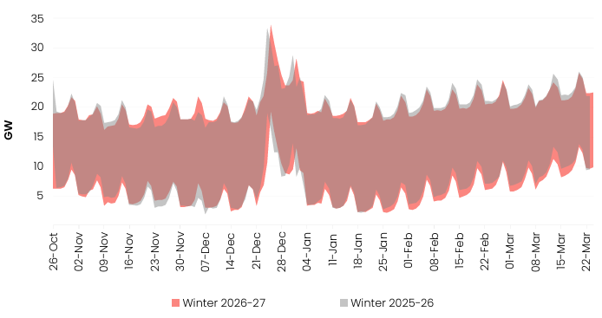
The figure below shows NESO’s forecasted operational surplus for winter 2026/27 and last winter. It forecasts a small increase in demand for this winter; however, it expects this will be offset by increasing generation and storage capacity. NESO expects there will be some tight days, mainly in mid and late January, that could require the use of system notices. These predictions are made based on current submissions from generators, which are likely to change before the release of the full report in October.
In its 2025/26 winter review and consultation, NESO notes that actual available conventional generation was largely below what it had forecast in its outlook for much of the winter period. This was due to extended generator outages and new outages occurring once the forecast was published. It seems to expect that this was an isolated or unforecastable occurrence, as it makes no mention of it in its approach to the outlook for the upcoming winter period.
Forecast operational surplus range for winter 2025/26 and 2026/27
Source: NESO
International markets
NESO forecasts that GB will be a net importer of electricity over the coming winter period, in line with recent years. This is primarily driven by GB wholesale prices trading at a premium to France. Flows from Belgium, Germany, Denmark, and the Netherlands will be more varied and price-responsive. NESO also anticipates French nuclear unavailability levels to be similar to last year (which is considerably lower than the five-year average), and Norwegian hydropower reservoir levels are likely to be slightly below the 10-year average, but there are currently no signs that exports to GB markets could be affected.
Going forwards
NESO is due to publish the full report in October this year, which will incorporate its latest demand and asset availability forecasts.
NESO will continue to monitor the effects of global gas market pressures, European electricity flows, and short-term impacts of weather, system tightness, and real-time conditions.
Disclaimer
We’ve used all reasonable efforts to ensure that the content in this article is accurate, current, and complete at the date of publication. However, we make no express or implied representations or warranties regarding its accuracy, currency or completeness. We cannot accept any responsibility (to the extent permitted by law) for any loss arising directly or indirectly from the use of any content in this article, or any action taken in relying upon it.
Subscribe to our newsletter
Sign up to our monthly newsletters and get the best of Drax Insights sent directly to your inbox.


